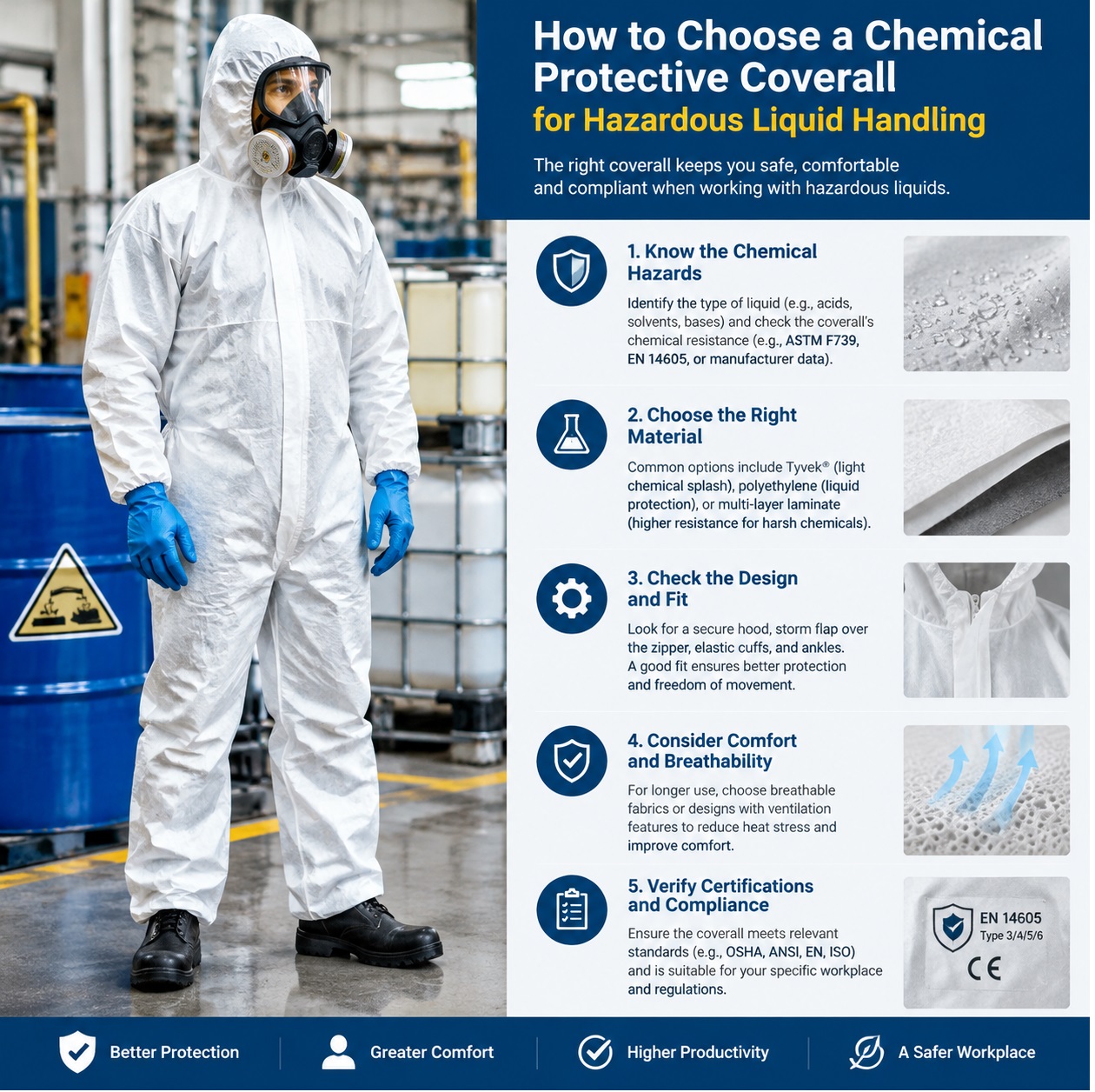
 The phrase “chemical resistant” on a coverall label is one of the most abused claims in industrial safety. There is no such thing as a universally chemical-resistant garment. Every suit that claims that title is resistant to a specific chemical, at a specific concentration, for a specific duration, and nothing more. Anyone who tells you otherwise is selling you something, and they might be selling you a false sense of security that gets someone hurt.
That single idea should govern every decision you make about protective coveralls for hazardous liquid handling. Not the color. Not the price per unit. Not whatever the last vendor shoved across your desk. The chemistry of the job, the physics of the exposure, and the honest limits of the garment.
Start with the exposure, not the garment.
Before you look at a single spec sheet, write down what your workers are actually handling. Liquid splashes are not the same threat as pressurized spray, which is not the same threat as an immersion event or a vapor-heavy environment. A splash that lands on a sleeve and rolls off is a different physics problem than a jet of solvent hitting a zipper at close range. The suit has to match the scenario.
This is where the European Type classification becomes useful, even if you’re buying in another region. Type 6 covers light liquid splash. Type 4 covers liquid spray. Type 3 covers liquid jet. Type 5 handles airborne solid particles. If your task involves decanting drums, you’re probably in Type 4 or Type 3 territory. If it’s cleaning up a puddle, Type 6 might genuinely suffice. The mistake is buying one classification for every job on site because it simplifies procurement. Convenience is a terrible reason to under-protect a worker.
Understand what permeation actually means.
Most buyers fixate on penetration, which is liquid leaking through holes, seams, or zippers. Permeation is the quieter killer. It’s a chemical moving through the fabric itself at a molecular level, with no visible hole and no visible wet spot. By the time the worker feels something, the exposure has already happened. The suit looked intact the entire time.
That’s why you need to read chemical resistance charts properly. Every reputable manufacturer publishes permeation data with a breakthrough time, usually measured in minutes. A breakthrough time of 10 minutes for a given chemical means the suit offers meaningful protection for roughly that window under test conditions. If your task takes 45 minutes, a 10-minute breakthrough time is not protection. It’s a countdown timer.
Find the chart for the exact chemical you’re handling, at the concentration you’re using, and compare it to the duration of the task. If the breakthrough time doesn’t comfortably exceed the work window, move to a different material.
Match the material to the chemistry.
Polyethylene and polypropylene spunbond fabrics are inexpensive and fine for dry particulates and light aqueous splashes. They are a poor choice for aggressive solvents. Microporous films and laminates offer better liquid holdout but still vary wildly depending on the specific film. Tyvek, Tychem, and similar branded materials each have distinct chemical performance profiles, and the grades within a single brand line can differ substantially.
The trap here is brand loyalty. A company standardizes on one coverall line and assumes it’s appropriate for every chemical on site. Then a new solvent arrives, nobody revisits the garment selection, and the protection gap opens silently. Chemical compatibility is a moving target. Treat it that way.
Do not ignore the physical construction details.
A coverall is only as strong as its weakest seam. Stitched seams can wick liquid. Taped or heat-sealed seams close that path. If you’re handling liquids with any real hazard profile, taped seams are not a premium upgrade. They’re the baseline.
Zippers need a storm flap. Elastic cuffs need to sit snug against a glove, not gap open. The hood-to-respirator interface matters if there’s any vapor concern. Ankles need to overlap boots properly. These aren’t cosmetic details. They are the exact points where real-world exposure happens, and they’re the first things cut when a manufacturer trims costs.
Also think about what happens after the suit is worn. A contaminated coverall is hazardous waste. Can it be safely removed without touching the outside surface? Is there a designated doffing procedure? A perfect suit with a sloppy removal protocol still ends in exposure.
Fit and heat stress deserve real weight.
An oversized coverall catches on equipment and tears. An undersized one restricts movement, which leads to workers skipping it or modifying it, both of which defeat the purpose. More importantly, coveralls trap heat. In a warm plant or a summer job site, heat stress can become a bigger immediate danger than the chemical itself. There’s a real tradeoff between barrier performance and breathability, and pretending it doesn’t exist puts workers in a position where they choose between overheating and being unprotected.
If the task is short and the chemical is aggressive, accept the heat and manage work-rest cycles. If the task is long and the chemical is mild, a lighter fabric might genuinely be the safer overall choice. That’s an honest engineering decision, not a compromise.
Build a selection checklist you actually use.
Identify the specific chemical, concentration, and physical state. Determine whether the exposure risk is splash, spray, jet, immersion, or vapor. Set the maximum task duration and add a safety margin. Pull the permeation and penetration data for candidate materials against that specific chemical. Confirm the garment’s Type classification matches the exposure mode. Inspect seam construction, closure design, and the glove and boot interface. Size for the largest worker who will wear it and test mobility. Establish a donning and doffing procedure and a disposal plan. Train everyone who touches the suit on its limits, not just its features.
If a supplier can’t give you permeation data for your specific chemical, that’s your answer. Walk away. A coverall without verifiable chemical performance data is a costume, not protective equipment.
The bottom line is uncomfortable but simple. Choosing a chemical protective coverall is a chemistry problem wrapped in a garment. The moment you let price, convenience, or brand familiarity drive the decision, you’ve stopped doing safety and started doing procurement theater. Get the chemistry right first. Everything else follows from there.
Categories: Business
