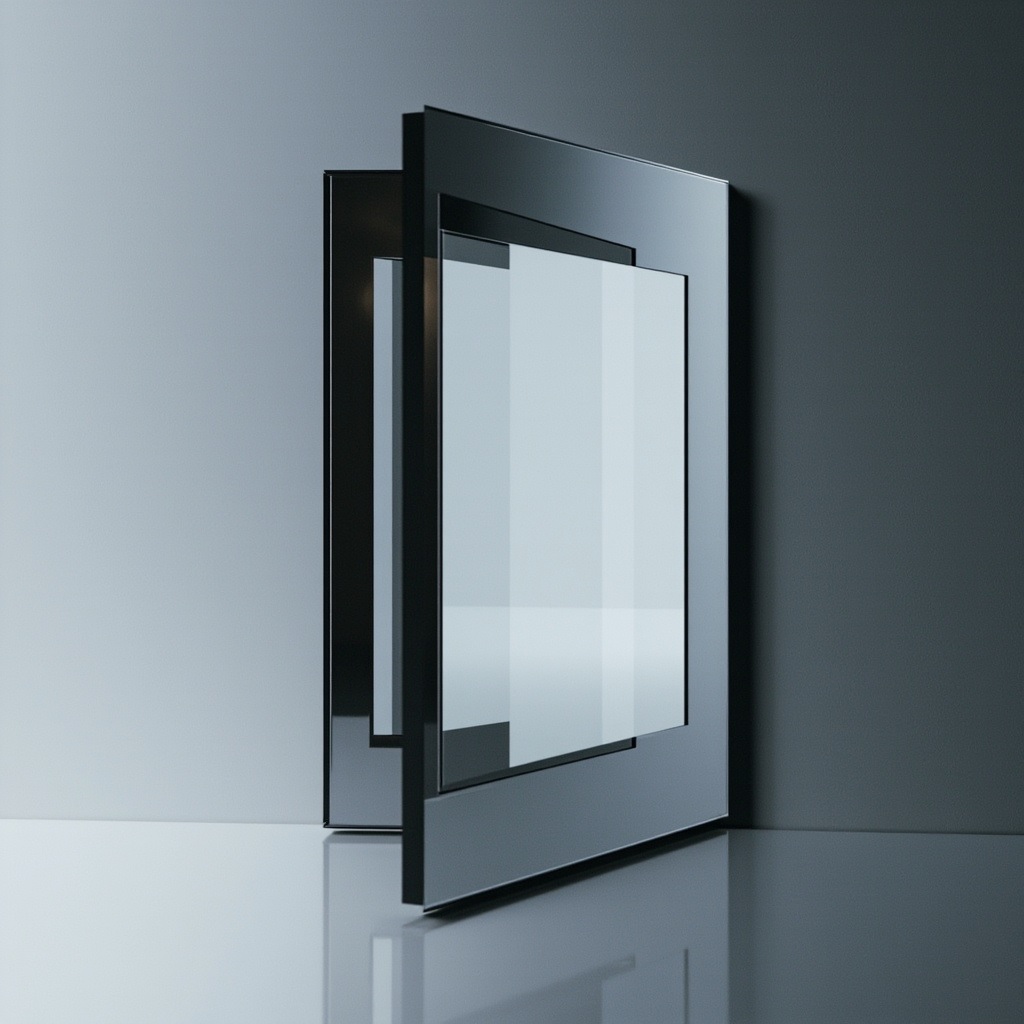
 The first time a client asked me for a mirror that looked like a hole in the wall, I laughed. Then I realized they weren’t joking. They wanted the impossible: a massive reflective surface that appeared to float in mid-air, unsupported, unbound, a pure optical hallucination. The catch? Building codes demanded a frame. Physics demanded a structure. And aesthetics demanded we lie perfectly. That is the brutal, beautiful challenge of designing ultra-narrow Aluminum Alloy Mirror Frame illusions. We are not making a product. We are engineering a visual lie, and the frame is the only evidence we have to hide.
Most people think “frameless” means no frame. It is a comforting myth. In reality, frameless mirrors rely on a structural skeleton so thin, so precise, that the human eye refuses to register it. The magic happens in the millimeter. A standard frame might be an inch thick, a bulky confession of engineering. Our approach flips that. We use high-strength 6061-T6 aluminum alloy, a material that laughs at deflection. We machine it down to a razor-thin 8mm profile. That is thinner than a pencil. The frame disappears because the brain categorizes it as a shadow, not a border.
But thinness is worthless without rigidity. Here is the dirty secret of the trade: a flimsy frame warps under the weight of a large mirror, creating a wavy distortion that screams “fake.” You see the reflection bend, and the illusion shatters. Our solution is a proprietary internal channel design. We extrude the aluminum with a hidden T-slot that acts like a spine. It distributes the load evenly, preventing torsion even on mirrors over six feet tall. The frame holds the glass with a surgical grip, using silicone-set clips that are invisible from the front. No screws. No brackets. Just a seamless, floating edge.
The real trick, however, is the corner. A mitered corner on a standard frame leaves a visible seam, a tiny dark line that breaks the continuous reflection. For a true illusion, that line is a dead giveaway. We laser-cut the aluminum miters to a tolerance of 0.1mm and then back-weld them with a micro-TIG process. The weld is ground flush and anodized. The result? A corner that looks like a single, continuous piece of metal. The light flows over it without interruption. The mirror appears to have no beginning and no end.
Why does this matter for your space? Because a frame that announces itself kills the room. A thick, boxy border turns a mirror into a piece of furniture. An ultra-narrow alloy frame turns it into a portal. It opens up small bathrooms, making them feel twice their size. It turns a hallway into an infinite corridor. It makes a statement without shouting. The frame becomes a whisper, a necessary evil that the eye chooses to ignore.
We also obsess over the finish. A standard silver or white frame catches the light and creates a halo effect, a glowing ring around the mirror that ruins the illusion. We offer a matte black anodized finish that absorbs light. It creates a void. When you look at the mirror from a distance, the edge simply dissolves into the wall. Up close, you see a hairline of darkness. That is the only clue that the magic is real.
This is not a product for everyone. It is for the client who notices the gap between the baseboard and the floor. It is for the designer who demands that every detail serve the whole. It is for the person who wants a mirror that feels like a secret. We are selling an absence, a negative space, a trick of the light. And the only way to pull it off is with an aluminum frame so precise, so minimal, so aggressively engineered, that it dares you to see it. You won’t. And that is exactly the point.
Categories: Business
